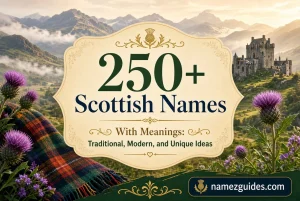
Scottish names carry a distinctive charm, shaped by centuries of history, Gaelic language, rugged landscapes, family traditions, and memorable legends. From names inspired by the Scottish Highlands to those associated with ancient clans, brave warriors, and beautiful natural scenery, Scotland offers plenty of inspiration for naming a pet, fictional character, mascot, or beloved plushie.
The best Scottish names can feel strong, gentle, mysterious, playful, or timeless. A name such as Angus might suit a sturdy dog, while Isla could be a lovely choice for a cat with a graceful personality. Names like Ailsa, Lachlan, and Bonnie also offer distinctive sounds and cultural connections without feeling overly complicated.
This guide explores traditional Scottish names, modern favorites, Gaelic-inspired choices, names with meaningful origins, and unusual ideas for different personalities. You will also find pronunciation guidance, creative naming tips, and suggestions to help you choose a name that feels memorable and appropriate for your subject.
🐾 Fun Fact About Scottish Names
Scotland has two living indigenous languages, Scottish Gaelic and Scots, alongside English. Scottish names reflect this linguistic diversity, as well as Norse, Celtic, and other historical influences.
Another interesting detail is that many familiar Scottish names are connected to the landscape. Isla is associated with the Scottish island of Islay, while Ailsa evokes Ailsa Craig, a distinctive island in the Firth of Clyde. Such connections make Scottish-inspired names particularly appealing for animals and characters associated with nature, adventure, or the Highlands.
🧭 How to Choose the Perfect Scottish Name
A Scottish name should fit the personality and purpose of the animal, character, or mascot you are naming. You do not need to choose the most historically traditional option; sometimes, a name with the right sound and feeling is a better match.
Consider these factors before making your decision:
- Personality: Choose Hamish for a friendly, approachable character, Angus for a sturdy and confident pet, or Bonnie for someone with a sweet, cheerful nature.
- Appearance: Heather can suit a purple-themed character, while Rowan may appeal to an animal with reddish-brown fur.
- Meaning: If symbolism matters, consider names such as Hope, Grace, or names with established Gaelic meanings.
- Pronunciation: Names such as Eilidh and Màiri have distinctive Gaelic pronunciations. Check the pronunciation before choosing one for everyday use.
- Length: Short names such as Isla, Skye, and Ross are convenient for pets. Longer names such as Alasdair can work well for fictional characters.
- Cultural connection: If you want a name rooted in Scottish heritage, distinguish between Gaelic names, Scots words, and names merely associated with Scotland.
- Story or role: A Highland-inspired name might suit an adventurous wolf character, while a gentle nature-inspired name could work beautifully for a plushie.
Practical tip: Say the name aloud several times. If it feels natural to pronounce, easy to remember, and appropriate for your subject, it is a promising choice.
🏴 Traditional Scottish Names
Traditional Scottish names have a timeless quality. Many are connected to Gaelic heritage, Scottish history, long-established naming customs, or families with generations of Scottish roots. They can suit dogs and cats just as well as historical characters, fictional heroes, and mascots with a classic personality.
Some names below have specifically Gaelic origins, while others are established names used in Scotland. These distinctions matter because not every popular Scottish name originated in the Gaelic language.
| Name | Meaning or origin | Best suited for |
| Angus | Anglicized form of Gaelic Aonghas; traditionally interpreted as “one choice” or “unique strength” | Strong dog or bold character |
| Alasdair | Scottish Gaelic form of Alexander; “defender of mankind” | Heroic character |
| Hamish | Scottish form of James, ultimately related to Jacob | Friendly pet |
| Ewan | Scottish form related to Eòghann; the deeper etymology is debated | Calm, approachable character |
| Lachlan | Traditionally associated with the land of the lochs and historical Norse connections | Adventurous pet |
| Duncan | From Gaelic Donnchadh, commonly interpreted as “brown warrior” | Brave character |
| Malcolm | From Gaelic Máel Coluim, traditionally interpreted as “devotee of Columba” | Noble character |
| Fergus | From Gaelic Fearghas, associated with strength or vigor | Energetic dog |
| Iain | Scottish Gaelic form of John | Short, classic name |
| Màiri | Scottish Gaelic form of Mary | Gentle character |
| Seumas | Scottish Gaelic form of James | Traditional male character |
| Donnchadh | Gaelic form behind Duncan | Historically inspired character |
| Catriona | Scottish form related to Katherine | Elegant character |
| Morag | Traditional Scottish Gaelic feminine name | Warm, distinctive pet |
| Elspeth | Scottish form related to Elizabeth | Vintage character |
| Aonghas | Gaelic form of Angus | Culturally rooted name |
| Niall | Gaelic name of debated etymology | Bold, concise name |
| Ealasaid | Scottish Gaelic form of Elizabeth | Traditional female character |
These names are particularly useful when you want an identity that feels connected to Scottish history rather than simply sounding Scottish. For a pet, Angus, Iain, and Morag are relatively recognizable options. For a historical or fantasy character, Alasdair, Donnchadh, and Ealasaid provide a stronger traditional atmosphere.
🌿 Scottish Gaelic Names With Meanings
Scottish Gaelic names are an excellent choice when you want a name with a linguistic and cultural connection to Scotland. Their meanings, sounds, and spellings can differ from English naming conventions, so pronunciation deserves attention.
Not every Gaelic name has a single universally agreed-upon etymology. The table focuses on established forms and commonly reported meanings or associations rather than assigning a literal translation to every name.
| Name | Meaning or association | Naming style |
| Ailbhe | An old Gaelic name; its original meaning is uncertain | Rare and traditional |
| Ailsa | Associated with Ailsa Craig and the Scottish island-name tradition | Nature-inspired |
| Eilidh | Scottish Gaelic form associated with Helen; commonly linked to light | Gentle and graceful |
| Eòin | Gaelic form of John in Scottish usage | Traditional and concise |
| Fionn | Gaelic name meaning “fair” or “white” | Mythological or nature-inspired |
| Gillebrìde | Gaelic name associated with the servant or devotee of Brigid | Historical character |
| Iseabail | Scottish Gaelic form of Isabel | Elegant and traditional |
| Màiri | Gaelic form of Mary | Familiar and classic |
| Naoise | Gaelic mythological name, especially associated with Irish tradition | Legendary character |
| Oighrig | Traditional Scottish Gaelic feminine name | Unusual choice |
| Ruairidh | Scottish Gaelic form related to Rory; commonly associated with a red king | Bold character |
| Somhairle | Gaelic form of a name related to Somerled, with Norse roots | Historical character |
| Tormod | Scottish Gaelic form related to Norman | Traditional male name |
| Uilleam | Scottish Gaelic form of William | Strong and classic |
| Ùna | Scottish Gaelic form of Una | Short and distinctive |
| Mòrag | Gaelic feminine name, often treated as a form related to Sarah or Margaret in Scottish naming traditions | Warm and traditional |
Pronunciation note: Eilidh is commonly pronounced approximately “AY-lee,” while Ruairidh is often pronounced “ROO-ree.” Gaelic pronunciation varies by dialect and local usage, so checking a native-speaker recording is worthwhile when accuracy matters.
For a pet, a name does not need to be easy for everyone to spell, but it should be comfortable for the people who will use it daily. For a character with a Gaelic background, correct spelling and cultural context can make the choice more meaningful.
✨ Unique Scottish Names
If familiar choices such as Angus, Isla, and Bonnie feel too common, consider names that are less frequently encountered in everyday naming. Unusual Scottish names can bring individuality to a pet, fictional creature, gaming character, or creative mascot.
Some choices below are established names with Scottish or Gaelic connections; others are words and place names associated with Scotland. Their inclusion does not mean that every option is traditionally used as a personal name.
| Name | Meaning or association | Type |
| Ailsa | Scottish island-name association | Established name |
| Arran | Scottish island in the Firth of Clyde | Place-inspired |
| Brìghde | Gaelic form of Brigid, a name associated with strength and traditional Irish and Gaelic heritage | Traditional name |
| Cailean | Scottish Gaelic form related to Colin; its deeper origin is debated | Established name |
| Ciorstaidh | Scottish Gaelic form of Kirsty or Christina | Traditional name |
| Dòmhnall | Scottish Gaelic form of Donald | Traditional name |
| Eilionoir | Scottish Gaelic form associated with Eleanor | Traditional name |
| Eiric | Gaelic-associated name form; meanings vary by historical interpretation | Heritage-inspired |
| Griogair | Scottish Gaelic form of Gregory | Traditional name |
| Innes | Scottish surname and place-name tradition | Surname-inspired |
| Lennox | Scottish territorial surname | Strong and modern |
| Lorne | Scottish place-name and established personal name | Understated |
| Màrtainn | Scottish Gaelic form of Martin | Traditional name |
| Ness | Associated with Loch Ness and Scottish place names | Short and mysterious |
| Tavish | Scottish form related to Thomas | Distinctive |
| Torquil | Scottish name with Norse-Gaelic historical connections | Bold and unusual |
| Struan | Scottish name associated with Gaelic naming and place-name traditions | Nature-inspired |
| Skye | Name of the Scottish island | Modern and scenic |
For a distinctive pet name, Ness, Skye, Arran, and Struan are short enough to use easily. For a fantasy character, Torquil, Ciorstaidh, or Griogair may offer a more unusual sound and a stronger cultural atmosphere.
🐶 Scottish Dog Names
Scottish dog names can reflect loyalty, energy, sturdiness, friendliness, or the adventurous spirit associated with Highland landscapes. You can choose a traditional name for a Scottish breed, a place-inspired name for a hiking companion, or a playful option for a dog whose personality is more charming than intimidating.
The following suggestions mix established Scottish names with Scottish places and familiar words. Place-inspired names are labeled accordingly rather than being presented as traditional Gaelic personal names.
| Name | Meaning or association | Best for |
| Angus | Traditional Scottish name | Strong, confident dog |
| Hamish | Scottish form of James | Friendly companion |
| Fergus | Gaelic-associated name linked with vigor | Energetic dog |
| Skye | Scottish island | Adventurous dog |
| Brodie | Scottish surname and place-name tradition | Playful companion |
| Arran | Scottish island | Outdoorsy dog |
| Clyde | Scottish river name | Calm, sturdy dog |
| Wallace | Scottish surname associated with William Wallace | Brave character or dog |
| Mack | Short form or nickname associated with Scottish surnames beginning with Mac | Confident dog |
| Lachlan | Traditional Scottish name | Intelligent, adventurous dog |
| Bonnie | Scots word meaning pretty or attractive | Sweet-natured dog |
| Nessie | Familiar nickname associated with the Loch Ness Monster | Quirky companion |
| Duncan | Traditional Scottish name | Bold, reliable dog |
| Iain | Scottish form of John | Short, simple name |
| Morag | Scottish name | Independent dog |
| Glen | Scots and Scottish Gaelic landscape association | Nature-loving companion |
| Heather | Name of a plant common in Scottish landscapes | Gentle dog |
| Rowan | Tree name with Gaelic and broader Celtic associations | Red or brown-coated dog |
Naming tip: Dogs often learn their names more easily when the spoken form is clear and consistent. You can use a longer traditional name formally and a shorter nickname at home, such as Lachlan and Lachie, while keeping one familiar spoken name for everyday cues.
🐱 Scottish Cat Names
Cats can suit almost any naming style, but Scottish names are particularly appealing when you want something elegant, mysterious, playful, or connected to rugged scenery. A quiet cat might suit Isla or Eilidh, while a mischievous one could wear Nessie or Hamish surprisingly well.
Scottish place names are also useful for cats because they can evoke misty islands, old stone villages, dramatic coastlines, and peaceful countryside without needing a complicated backstory.
| Name | Meaning or association | Personality or appearance |
| Isla | Associated with the Scottish island of Islay | Graceful cat |
| Ailsa | Scottish island association | Elegant cat |
| Bonnie | Scots word meaning pretty or attractive | Affectionate cat |
| Nessie | Nickname associated with the Loch Ness Monster | Curious cat |
| Skye | Scottish island | Independent cat |
| Morag | Traditional Scottish name | Confident cat |
| Màiri | Scottish Gaelic name | Gentle cat |
| Heather | Scottish landscape plant | Soft-natured cat |
| Rowan | Tree name | Reddish or brown cat |
| Alba | Latin name for Scotland; also used as a feminine name | Regal cat |
| Eilidh | Scottish Gaelic name | Quiet, graceful cat |
| Innes | Scottish surname and place-name tradition | Reserved cat |
| Clyde | Scottish river name | Relaxed cat |
| Aonghas | Gaelic form of Angus | Bold male cat |
| Mòrag | Scottish Gaelic name | Independent female cat |
| Skerry | A small rocky island, especially in coastal regions | Adventurous cat |
| Oran | Scottish Gaelic-associated name, commonly linked to “little pale green one” in traditional interpretations | Calm cat |
| Laddie | Scots word for a boy or young man | Friendly male cat |
For a cat, the best name is often one you enjoy saying in an ordinary voice. Try calling it from another room and using it during feeding or play. If the name feels natural and is easy for everyone in the household to remember, it is a strong candidate.
👑 Male Scottish Names
Male Scottish names range from familiar classics to distinctive Gaelic forms and surnames. Some feel strong and historic, while others are relaxed and approachable. This category works well for male pets, fictional heroes, Highland-inspired characters, and mascots that need a recognizable Scottish identity.
| Name | Meaning or origin | Style |
| Alasdair | Form of Alexander; “defender of mankind” | Noble |
| Angus | Form of Aonghas | Strong |
| Callum | Scottish form associated with Columba; traditionally interpreted as “dove” | Gentle |
| Duncan | From Donnchadh | Classic |
| Ewan | Scottish name related to Eòghann | Friendly |
| Fergus | From Fearghas | Powerful |
| Finlay | From Gaelic Fionnlagh, commonly associated with a fair warrior | Adventurous |
| Fraser | Scottish surname with historical roots in Scotland | Distinguished |
| Gordon | Scottish surname and established personal name | Formal |
| Hamish | Scottish form of James | Warm |
| Iain | Scottish form of John | Simple |
| Lachlan | Scottish name with historical Norse-Gaelic connections | Rugged |
| Malcolm | From Máel Coluim | Traditional |
| Murdo | Scottish form related to Murdoch | Unusual |
| Neil | Name used widely in Scotland; its etymology is debated | Classic |
| Ross | Scottish surname and place-name tradition | Short |
| Ruairidh | Scottish Gaelic form related to Rory | Bold |
| Seumas | Scottish Gaelic form of James | Heritage-inspired |
| Tavish | Scottish form related to Thomas | Distinctive |
| Uilleam | Scottish Gaelic form of William | Traditional |
If you want a strong name without an overly formal feel, Angus, Ross, and Finlay are easy choices. Alasdair and Uilleam offer a more traditional Gaelic appearance, making them especially useful for historical fiction or a character with a clearly Scottish background.
🌸 Female Scottish Names
Female Scottish names include lyrical Gaelic forms, traditional names passed down through generations, and modern choices inspired by Scotland’s islands and natural scenery. Some are immediately recognizable, while others offer a more distinctive cultural identity.
The options below include established Scottish names and names used in Scotland that have broader origins. The meaning column identifies their established connection without assigning unsupported literal translations.
| Name | Meaning or origin | Style |
| Ailsa | Scottish island-name association | Distinctive |
| Bonnie | Scots word meaning pretty or attractive | Cheerful |
| Catriona | Scottish form related to Katherine | Classic |
| Eilidh | Scottish Gaelic form associated with Helen | Graceful |
| Elspeth | Scottish form related to Elizabeth | Vintage |
| Fiona | Popularized in literary usage and associated with Scottish naming; its Gaelic derivation is debated | Elegant |
| Isla | Associated with the Scottish island of Islay | Modern |
| Iseabail | Scottish Gaelic form of Isabel | Traditional |
| Jean | Scottish usage of a name related to Jane | Timeless |
| Kirsty | Scottish form related to Christina | Friendly |
| Màiri | Scottish Gaelic form of Mary | Traditional |
| Morag | Scottish Gaelic feminine name | Distinctive |
| Mòrag | Gaelic spelling of Morag | Heritage-inspired |
| Shona | Scottish form associated with feminine forms of John | Familiar |
| Skye | Scottish island-name association | Nature-inspired |
| Una | Name with several possible linguistic origins, used in Scotland | Simple |
| Ùna | Scottish Gaelic form of Una | Short |
| Davina | Feminine form associated with David | Refined |
| Maisie | Scottish diminutive of Margaret | Playful |
| Rhona | Scottish feminine name, also associated with the island of Rona | Uncommon |
Best for an elegant character: Catriona, Elspeth, and Iseabail.
Best for a modern pet name: Isla, Skye, and Maisie.
Best for a strong cultural connection: Eilidh, Màiri, and Morag, particularly when their Gaelic spellings and pronunciations are used thoughtfully.
😂 Funny and Playful Scottish Names
A humorous Scottish-inspired name can be a memorable choice for a pet, plushie, gaming character, or mascot. Rather than relying on exaggerated accents or cultural stereotypes, these ideas draw on familiar Scottish words, place names, food references, and folklore.
Some options are playful nicknames rather than traditional personal names. That is part of their appeal: the goal is a lighthearted name, not a claim about Scottish naming history.
| Name | Inspiration | Best suited for |
| Nessie | Loch Ness Monster folklore | Curious pet |
| Haggis | Traditional Scottish dish | Round, cuddly pet |
| Tattie | Scots word for potato | Small, funny pet |
| Wee Beastie | Scots expression for a little creature | Mischievous mascot |
| Bonnie Boo | Playful combination using Scots “bonnie” | Sweet plushie |
| Bagpipe | Traditional Scottish musical instrument | Loud, energetic character |
| Shortbread | Scottish biscuit tradition | Soft toy |
| Tartan | Scottish textile pattern | Colorful mascot |
| Kiltie | Playful reference to the kilt | Cartoon character |
| Braw | Scots word meaning excellent or fine | Confident pet |
| Ceilidh | Scottish social gathering featuring music and dancing | Energetic character |
| Skedaddle | Playful English word for running away | Mischievous animal |
| Lochie | Nickname inspired by Scottish lochs | Friendly pet |
| McFluff | Invented humorous name using a Scottish surname prefix | Fluffy cat |
| Sir Paws-a-Lot | Original pun | Pampered pet |
| Highland Hopper | Original playful phrase | Bouncy character |
| Bonnie Bairn | Uses Scots “bairn,” meaning child | Cute mascot |
| Nessie Nibbles | Original alliterative name | Food-loving pet |
For a real pet, funny names work best when they remain easy to call out and are comfortable to use around other people. For a plushie or cartoon mascot, you can be more imaginative with longer names and elaborate puns.
🏔️ Scottish Nature and Place-Inspired Names
Scotland’s landscape offers an enormous range of naming inspiration, from islands and rivers to mountains, lochs, plants, and coastal features. These names can evoke a sense of freedom, mystery, calm, or rugged beauty.
This category is especially useful for animals with outdoor-loving personalities, fantasy characters who travel through wilderness, and mascots connected to environmental or travel themes.
| Name | Meaning or connection | Style |
| Alba | Latin name historically used for Scotland | Cultural |
| Arran | Scottish island | Adventurous |
| Ailsa | Scottish island-name association | Elegant |
| Ben | Common Scottish mountain-name element, from Gaelic beinn, meaning mountain | Strong |
| Cairn | Pile of stones, often used as a trail marker | Rugged |
| Clyde | River in Scotland | Classic |
| Dee | Name of rivers in Scotland | Short |
| Etive | Scottish river and glen name | Distinctive |
| Glen | Valley, from Scots and Gaelic usage | Calm |
| Heather | Flowering plant common in Scottish landscapes | Gentle |
| Jura | Scottish island | Mysterious |
| Lomond | Associated with Loch Lomond and the surrounding landscape | Scenic |
| Ness | Associated with Loch Ness and Scottish place names | Short |
| Orkney | Scottish archipelago | Unusual |
| Rowan | Tree name with Celtic and Gaelic associations | Nature-inspired |
| Skye | Scottish island | Modern |
| Struan | Scottish name also associated with place-name traditions | Traditional |
| Tay | Scotland’s longest river | Simple |
| Torridon | Highland area known for dramatic mountain scenery | Grand |
| Uist | Name associated with islands in the Outer Hebrides | Distinctive |
Why this style works: Place names often carry a story without needing an invented meaning. A character called Torridon might inhabit a mountainous fantasy world, while Tay could suit a calm, flowing-water-themed mascot. If you use a name such as Ben, keep in mind that it is also a common personal name, not exclusively a mountain reference.
🛡️ Scottish Names Inspired by History and Legends
Scottish history and folklore provide material for characters who need a sense of courage, leadership, mystery, or ancient heritage. Historical figures, traditional stories, and place-associated legends can be particularly useful for fantasy writing, role-playing games, and distinctive mascot identities.
A name’s historical association does not necessarily describe its literal meaning. The following list separates the person or legend from the naming interpretation.
| Name | Historical or legendary connection | Best suited for |
| Wallace | Associated with William Wallace, a major figure in the Wars of Scottish Independence | Brave hero |
| Bruce | Associated with Robert the Bruce, King of Scots | Royal character |
| Robert | Name of Robert the Bruce | Leader |
| Macbeth | Associated with the historical Scottish king and Shakespeare’s tragedy | Dramatic character |
| Macbeth’s Banquo | Banquo is a character in Shakespeare’s play, not a securely documented historical figure in the same form | Fictional companion |
| Flora | Associated with Flora MacDonald, who helped Charles Edward Stuart escape capture | Courageous character |
| Bonnie Prince Charlie | Popular name for Charles Edward Stuart | Historical-themed mascot |
| Rob Roy | Associated with the Scottish outlaw and folk hero Rob Roy MacGregor | Adventurer |
| MacGregor | Scottish clan surname associated with Rob Roy MacGregor | Clan-inspired character |
| Bruce | Scottish surname and royal association | Strong pet |
| Douglas | Scottish surname associated with a powerful historic family | Noble character |
| Stewart | Scottish royal and clan surname | Regal character |
| Stuart | Variant spelling associated with the Scottish royal dynasty | Historical character |
| Somerled | Medieval Norse-Gaelic ruler associated with the western seaboard of Scotland | Warrior character |
| Fingal | Name associated with Scottish literary tradition and the Ossianic legends | Mythic hero |
| Selkie | Folkloric being that changes between seal and human form in Scottish and other North Atlantic traditions | Magical creature |
| Kelpie | Water spirit in Scottish folklore, often depicted as a shape-shifting horse | Fantasy creature |
| Nessie | Popular name for the legendary Loch Ness Monster | Playful mythical creature |
For a historically grounded character, choose a name associated with a real person or period and research the details of that connection. For a fantasy creature, folklore-inspired names such as Kelpie or Selkie can signal mystery without pretending that the creature is a real animal.
One useful distinction: Macbeth was a historical king of Scotland, but Shakespeare’s portrayal is a literary adaptation. Similarly, some legendary figures and stories have uncertain historical foundations. Treating those differences carefully makes a naming guide more reliable.
🧚 Scottish Fantasy Names for Fictional Characters
Fantasy names work best when they support the character’s world and personality. Scottish and Gaelic sounds, Highland place names, folklore, and historical surnames can provide inspiration without requiring every name to be a direct reference to a real historical person.
The established names in the table have cultural or historical connections. The final entries are explicitly identified as original creative constructions, so their suggested meanings are imaginative rather than linguistic facts.
| Name | Meaning or inspiration | Type |
| Alasdair | Scottish form of Alexander | Established name |
| Aonghas | Gaelic form of Angus | Established name |
| Catriona | Scottish form related to Katherine | Established name |
| Eilidh | Scottish Gaelic name | Established name |
| Fingal | Scottish literary and legendary associations | Literary-inspired |
| Kelpie | Scottish folkloric water spirit | Folklore |
| Selkie | Seal-human being in North Atlantic folklore | Folklore |
| Torquil | Name with Norse-Gaelic historical connections | Established name |
| Struan | Scottish name with place-name associations | Established name |
| Skye | Scottish island name | Place-inspired |
| Morrigan | Irish mythological figure, not specifically Scottish | Broader Celtic mythology |
| Avalon | Legendary island from Arthurian tradition | Broader literary mythology |
| Brannoch | Original construction suggesting a rugged Highland guardian | Creative |
| Caelwyn | Original fantasy construction suggesting a misty, pale landscape | Creative |
| Dunvara | Original construction inspired by Scottish dùn, meaning fort or stronghold | Creative |
| Eirnloch | Original construction combining a Gaelic-inspired sound with “loch” | Creative |
| Fearnwick | Original construction inspired by Scottish place-name sounds | Creative |
| Glenvara | Original construction suggesting a hidden valley | Creative |
| Thistlethorn | Original compound inspired by Scotland’s national floral emblem | Creative |
| Wyndrake | Original fantasy compound combining “wynd” and “drake” | Creative |
If you are creating a fantasy name from scratch, begin with the character’s role. A guardian might need hard consonants and a firm rhythm, while a healer or woodland spirit might suit softer sounds. You can borrow inspiration from Scottish landscape vocabulary, but avoid presenting invented combinations as authentic Gaelic.
For a more culturally grounded story, an established Scottish name paired with a fictional surname or title can be more convincing than a made-up name with a falsely claimed ancient meaning.
🧸 Scottish Names for Plushies, Toys, and Mascots
A plushie or mascot can carry a more affectionate or whimsical name than a real animal or serious character. Scottish words, foods, landscapes, and folklore offer an enjoyable starting point, especially if the toy has a tartan design, a Highland theme, or a soft and cuddly appearance.
You can also give the plushie a formal name and a shorter everyday nickname. This works particularly well for characters used in children’s stories, social media, classroom activities, or brand mascots.
| Name | Inspiration | Personality |
| Bonnie | Scots word meaning pretty or attractive | Sweet |
| Wee Hamish | Affectionate use of “wee” with a Scottish name | Tiny and friendly |
| Nessie | Loch Ness Monster folklore | Curious |
| Haggis | Scottish dish | Silly and lovable |
| Tattie | Scots word for potato | Round and cuddly |
| Skye | Scottish island | Dreamy |
| Heather | Scottish landscape plant | Gentle |
| Glen | Scottish landscape term | Calm |
| Lochie | Nickname inspired by lochs | Friendly |
| Angus Bear | Traditional name paired with a plushie type | Sturdy |
| Isla Puff | Original compound | Soft and delicate |
| Bonnie Buttons | Original playful compound | Cheerful |
| Highland Hug | Original affectionate name | Comforting |
| Tartan Tots | Original alliterative name | Group mascot |
| Sir Shortbread | Original humorous name | Grand and silly |
| Wee Thistle | Scottish floral inspiration | Small but spirited |
| Fuzzy Fraser | Original alliterative name | Fluffy |
| Skerry | Coastal landform term | Adventurous |
Naming tip: Consider how the name looks on a label, appears in a story, and sounds when a child says it. Short names such as Skye and Nessie are easy to remember, while longer names such as Sir Shortbread can give a mascot a humorous identity.
🎨 How to Create Your Own Scottish-Inspired Name
You do not need to select an existing name to create something distinctive. A thoughtful combination of Scottish landscape references, established names, and fictional elements can give your pet or character an identity that feels personal.
1. Start with a real Scottish reference
Choose a place, landscape feature, plant, or established name. Examples include Skye, Arran, Glen, Heather, and Angus. Using a real reference gives the name a recognizable starting point.
2. Match the sound to the personality
Harder sounds can feel bold or dramatic, while softer sounds may seem gentle or playful. Compare Torquil for a stern warrior character with Isla for a graceful woodland creature. These are subjective impressions, not fixed rules about what names mean.
3. Combine words carefully
A compound such as Highland Ember could suit a fire-themed character, while Thistle Moon might work for a mysterious woodland mascot. These are original creative names, not traditional Scottish names.
4. Decide whether authenticity matters
If your character is meant to have a real Scottish or Gaelic background, verify the spelling, pronunciation, and cultural context. If the character belongs to an invented fantasy world, you have more freedom, but you should label invented meanings honestly.
5. Test the name in context
Try the name in a sentence, dialogue line, pet command, or character introduction. A name that looks attractive in a list might feel awkward when spoken repeatedly.
For example:
- “Skye, come here!”
- “Alasdair led the group through the Highland pass.”
- “Little Nessie guarded the plushie castle.”
If the name works in the situation where it will be used, it is more likely to remain appealing over time.
❓ Frequently Asked Questions
What are the most popular Scottish names?
Names such as Isla, Angus, Hamish, Lachlan, and Bonnie are recognizable choices associated with Scotland. Popularity varies by location, age group, and whether you are naming a child, pet, or fictional character. If you want a less familiar option, consider Struan, Torquil, or Ealasaid.
What Scottish name means strong?
Fergus is associated with strength or vigor through its Gaelic roots. Angus is traditionally interpreted in ways that include “one choice,” rather than simply meaning strong. For a character intended to appear powerful, the historical associations and sound of the name can matter as much as its literal meaning.
What is a good Scottish name for a dog?
Angus, Hamish, Skye, Bonnie, and Lachlan are useful options for dogs. Choose a name that suits your dog’s appearance and personality while remaining easy to say consistently. A short everyday form can help if the full traditional name is long.
Which Scottish names are suitable for fantasy characters?
Alasdair, Torquil, Fingal, Struan, and Kelpie can work well in fantasy settings. Alasdair and Struan are established names, Fingal has literary and legendary associations, and Kelpie refers to a figure from Scottish folklore. Original constructions are also useful, provided their invented meanings are not presented as historical facts.
Are Scottish Gaelic names difficult to pronounce?
Some Gaelic names have spellings that may be unfamiliar to English readers. Eilidh, Ruairidh, and Màiri are examples worth checking before use. Pronunciation differs by dialect and individual name, so a reliable audio recording or native-speaker guide is more useful than guessing from the spelling.
How do I know whether a name is genuinely Scottish?
Check whether it is an established Scottish personal name, a Scottish Gaelic form, a Scots word, a surname, a place name, or a reference to Scottish history or folklore. These categories overlap, but they are not interchangeable. For a culturally accurate choice, consult a reputable dictionary or place-name resource rather than relying only on a name list.
💭 Final Thought
The best Scottish name is one that feels right for the personality, appearance, and story behind the name. A traditional choice such as Angus or Màiri can express a connection to Scottish heritage, while Skye, Heather, and Arran draw inspiration from the country’s distinctive landscapes. If you prefer something playful, Nessie or Tattie might be a better fit.
Before making your final choice, say the name aloud, check its meaning and pronunciation, and consider whether it will still suit the pet or character as it develops. If cultural authenticity matters, verify the name’s origin rather than relying on an attractive sound alone. A meaningful name does more than sound good: it gives the person, pet, or character a memorable identity.